Key takeaways
- Work top-down, in a fixed order. Empty it, utilities off, pests checked, then doors and glass, roof covering, roof structure, walls, floor, base.
- Power, gas and water are not DIY. A qualified person disconnects them at the source before anyone pulls a wall.
- Kit sheds come apart in reverse. Metal and resin sheds are screwed and slotted together. Find the manual and run it backward.
- Old sheds hide hazards. EPA says not to saw or sand suspect asbestos; CDC says not to sweep or vacuum rodent droppings.
- Check the permit first. Denver exempts structures of 200 sq ft or less and 8 ft tall or less. Bigger ones need a demolition permit.
Tearing down a shed is a small demolition job. It isn't hard, but it has an order. Get the order wrong and a roof comes down on someone, a panel cuts a hand, or you end up with one mixed pile no transfer station wants. This guide covers the order of work, tools and safety gear, how wood, metal and plastic sheds differ, how much debris to expect, where it goes, and when to stop and call someone.
Still deciding whether to demolish, sell or move it? Start with how to get rid of a shed.
Before you start: permit, utilities and pests
Check whether you need a permit
Many cities exempt small sheds and require a permit for larger ones. Denver's demolition permit page says a structure of 200 square feet or less and 8 feet tall or less doesn't need one. Above that, you need a permit, and Denver wants approval from the Colorado Department of Public Health and Environment (CDPHE) first, even if the asbestos inspection found none. Denver's shed page adds that you need a demolition permit to remove an existing structure before building a new shed.
Your city's thresholds may differ. Read our shed demolition permit guide and confirm with your own building department. In Colorado, see our Colorado and Denver pages.
Empty it completely
Take everything out first. Old sheds collect fuel cans, paint, pesticides, pool chemicals and batteries. Those don't belong in a demolition load, so set them aside for your household hazardous waste program. Pull down shelves and pegboard too, so nothing falls when the walls move.
Utilities: a qualified person disconnects them
Plenty of sheds have power. Denver's shed rules allow up to two lights and two receptacles with an electrical permit, and older sheds often have wiring nobody permitted. A switched-off breaker can be switched back on, and a buried cable still runs to your panel.
- Electric: a licensed electrician disconnects the circuit at its source and makes it safe. Don't just cut the cable at the shed wall.
- Gas: a line to a heater or workshop gets capped by someone licensed for gas work. For permitted demolitions, Denver routes gas and electric disconnections through Xcel Energy.
- Water: a hose bib or sink line gets shut off and capped back at the supply.
Check for wasps, hornets and rodents
Look under the eaves, the roof overhang and the door frame before you start. NIOSH, the federal workplace-safety institute, says stinging insect nests turn up in trees, under roof eaves and even on ladders. It recommends light-colored, smooth clothing that covers as much skin as possible, staying calm rather than swatting, and carrying an EpiPen if you're allergic. Deal with an active nest before demolition, not during.
For mice and rats, CDC's clean-up steps are specific. Open doors and windows for 30 minutes and leave while it airs out. Wear rubber or plastic gloves. Soak droppings, urine and nests with disinfectant or 1.5 cups of bleach per gallon of water for 5 minutes. Don't sweep or vacuum them, because that can put virus-carrying droplets in the air. For heavy infestations, CDC says to wear a half-mask respirator with a HEPA filter.
Old materials: lead paint and asbestos
Lead paint. EPA says a home built before 1978 may have lead-based paint, and a shed from the same era is no different. Its DIY advice: mist surfaces before sanding, wear a disposable N-100 respirator, and bag waste in heavy plastic sealed with duct tape. Pulling painted boards apart makes much less dust than cutting or sanding them.
Asbestos. Old cement-board siding, corrugated roof panels and some roofing can contain asbestos, and you can't tell by looking. EPA tells homeowners not to saw, sand, scrape or drill material that may contain it, and to use trained, accredited professionals. In Colorado, CDPHE sets inspection trigger levels for single-family homes at 50 linear feet on pipes and 32 square feet on other surfaces; above those, a Colorado-certified inspector must check the material first.
Details for both are in old shed hazards. Read it before you go further if your shed is old.
Safety gear
OSHA groups protective equipment into eye and face, hearing, hand, foot, head, respiratory and body protection. For a shed teardown:
- Eyes: safety glasses, or goggles when working overhead. Rust, roofing grit and splinters fall straight down.
- Hands and arms: heavy gloves and long sleeves. Arrow's manual says both, because some parts have sharp edges.
- Feet and head: stiff-soled boots for upturned nails; a hard hat under the roof structure.
- Lungs and ears: a fitted respirator for dust, droppings or old paint; earplugs when a saw runs.
Old nails cause the classic shed injury. CDC's wound guidance says someone with a complete tetanus series needs a booster for a dirty wound if their last dose was 5 or more years ago.
Ladders and lifting
Don't stand on the roof. Arrow's manual says never to put your full weight on its roofs. Work from a ladder. OSHA's ladder card says to keep three points of contact, not to use the top step unless it's designed for it, to set the ladder on stable, level ground, and to look for overhead power lines first.
NIOSH puts the maximum two-handed lift, under ideal conditions, at 51 pounds, and says team lifting can cut each person's load in half. A wet sheet of plywood or a long wall panel is far from ideal. Plan on two people for walls and roof sections.
Tools for tearing down a shed
| Tool | What it's for | Shed types |
|---|---|---|
| Cordless drill/driver and bits | Backing out panel, hinge and trim screws. Arrow says a power driver speeds assembly by up to 40%. | All; essential for metal and resin |
| Screwdriver and wrenches | Stuck screws, nuts and bolts. Lifetime lists a Phillips screwdriver and 7/16" and 3/8" wrenches. | Metal, resin |
| Flat bar and wrecking bar | Prying trim, siding, sheathing, floor boards | Wood |
| Roofing shovel | Stripping shingles and felt | Shingled roofs |
| Reciprocating saw, demolition and metal blades | Cutting walls into sections, nails and all; cutting seized bolts | Wood, metal |
| Hammer and cat's paw | Pulling or bending over nails | Wood |
| Tin snips | Trimming torn panels so they stack flat | Metal |
| Stepladder | All roof work. Arrow lists one as required. | All |
| Tarps, bags, wheelbarrow | Catching grit and glass; moving debris | All |
| Truck, trailer or dumpster | Getting it gone | All |
How to tear down a shed, step by step
This order works for any shed. The sections after it cover what changes for wood, metal and plastic.
1. Pick a calm, dry day
Arrow tells owners not to assemble its sheds on a windy day because the large panels act as a sail, and warns that a partly assembled building can be badly damaged by light winds. A half-dismantled shed is in the same state.
2. Doors, windows and glass
Take the doors off their hinges or tracks first. They're heavy and they swing. Remove windows and skylight panels whole if you can. If glass breaks, tape it, bag it and keep it out of the wood pile.
3. Roof covering
On a wood shed, strip shingles and felt from the top down, working from a ladder, onto a tarp. On metal and resin sheds, the roof panels are the covering, so unscrew them. Keep roofing separate. EPA's conversion factor for asphalt roofing is 731 lb per cubic yard, more than four times that of loose lumber.
4. Roof structure
Then the sheathing, rafters or trusses, and ridge. This is the most dangerous stage, because the walls lose their bracing as the roof comes off. Take the roof apart piece by piece while the walls still stand. Never cut a wall and let the roof fall. Lifetime's manual says to have one person support the truss assembly as wall panels come out so it doesn't fall over.
5. Walls
Take walls down one at a time. Kit walls unscrew panel by panel. Wood walls can be stripped stud by stud or cut into sections. If a whole wall is coming down, it falls inward onto the floor, and everyone stands on the other side.
6. Floor
Pry up the plywood or boards, then the joists and skids. Expect rot and nests here, which is where CDC's no-sweeping rule matters most.
7. Base and anchors
The base might be bare ground, gravel, pavers, blocks, a timber frame or a slab. Kit sheds are usually anchored: Arrow sells auger-and-cable kits that twist into the ground and a concrete kit that lag-bolts into a slab. Unscrew the anchors or cut them off flush. If removing the base means digging, call 811 first. It's the free national before-you-dig service, and it asks for a few business days' notice. Slabs and footings are their own job; see shed foundation removal.
8. Sort, load and haul
Sort as you go: metal, clean wood, painted or treated wood, roofing, glass, trash. Scrap metal can go to a recycler, and some facilities handle clean wood or metal separately from mixed debris. Pull or bend over every nail before stacking boards.
Wood sheds
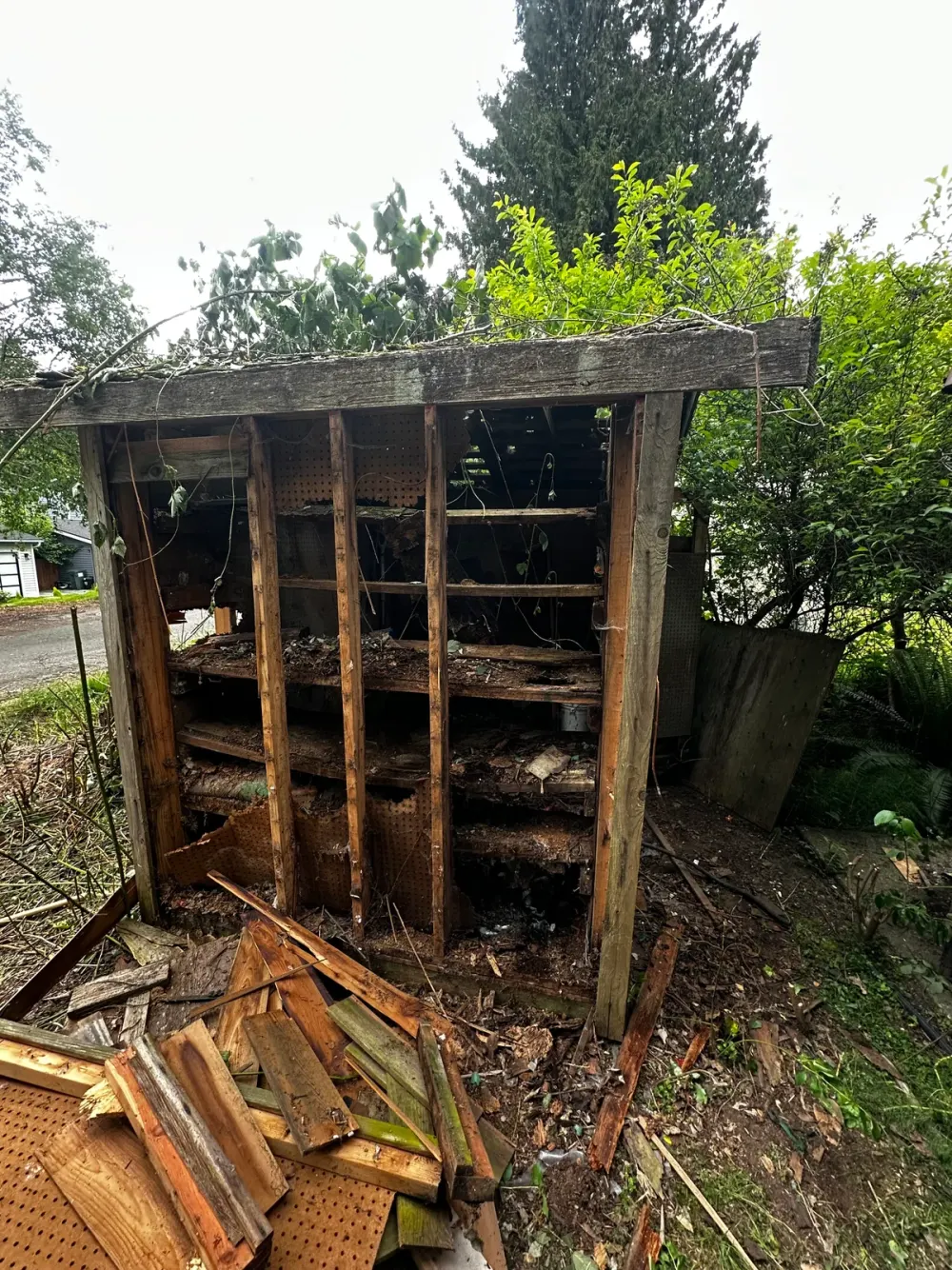
Wood sheds are framed buildings: siding on studs, sheathing and shingles on rafters, plywood on joists. They don't unscrew. You pry, cut and pull.
- Pry where paint may be old. Pulling boards apart makes less dust than sawing painted wood.
- Cut walls you can't lift. A reciprocating saw with a demolition blade goes through studs, siding and nails. Cut between studs into two-person sections.
- Watch for rot. A rotten sill or post can let a wall go early. Push-test before working beside it.
- Keep treated and painted wood separate. Some facilities limit it. King County takes treated wood from residential customers only in pieces 8 feet or shorter.
- Don't burn it. Haul painted and treated lumber instead.
Metal sheds
Most metal sheds are kits of thin steel or aluminum panels held by dozens of small screws with washers. They're light but sharp. Arrow's manual cautions that some parts have sharp edges and tells owners to wear work gloves, eye protection and long sleeves.
- Find the manual. Most brands keep them online. Disassembly is roughly its steps backward.
- Doors first. Sliding doors lift out of their tracks once the stops are off.
- Roof panels, then roof beams and gables. From a ladder, never from the roof.
- Wall panels and frame. Rusted screws may spin or snap. Drill out the head or cut the panel beside it.
- Floor frame and anchors. Unbolt from the slab or unscrew the augers. Cut seized lag bolts flush so they don't become trip hazards.
Torn panel edges are blades. Flatten and stack panels with sharp edges in, and tie them before carrying. A metal shed is often worth taking to a scrap recycler.
Resin and plastic sheds
Resin sheds from brands like Lifetime, Keter and Suncast are molded plastic panels, often steel-reinforced, that slot and screw together. They're the easiest to take down, and often the easiest to take down intact.
Lifetime's own manual shows how. Its instructions for extending an existing shed walk through a partial disassembly: remove any bolts or screws anchoring the shed to the ground, take off the roof panels and roof caps, unscrew a wall panel from its neighbors and the wall support, tip it inward, gently pry its bottom corner with a long flat screwdriver, and slide it out. One person supports the truss assembly meanwhile, and all hardware is saved.
For a full teardown, keep going until only the floor panels are left. Lifetime says two capable adults are required for assembly, and it recommends a low-torque setting so screws don't damage the plastic. Both apply in reverse. To reuse or sell it, see how to move a shed and selling or giving away a used shed.
Keter, Suncast and other brands use their own panel joints. Download the assembly manual for your model and work through it backward.
Rather not deal with it? We take sheds down, sort the debris and haul it away. Send photos and we'll quote it.
Get a shed removal quote ↗How long does it take?
The type of shed, the base and the dump runs matter more than the footprint.
- Kit sheds: Lifetime tells buyers to plan on a good part of a weekend to assemble one. Taking one apart is usually quicker, since nothing has to line up. As a rough planning guess rather than a measured figure, set aside a day for two people on a mid-sized kit.
- Framed wood sheds: Next Day Demolition, a Maryland company, says a typical shed demolition takes about 1 to 2 days. A first-timer should plan on the high end.
- Add-ons: rodent clean-up, rotten floors, a slab and each round trip to the transfer station all add time.
How much debris does a shed make?
Torn down, a shed's materials pile up loosely, so the volume is bigger than people expect. Budget Dumpster says its 10-yard dumpster, 14 feet long and 3.5 feet tall, holds about three pickup truckloads. Bin There Dump That recommends a 20-yard dumpster for most shed demolitions. Both rent dumpsters, so treat that as the generous end.
Weight is what landfills charge by. EPA's volume-to-weight conversion factors give typical weights per loose cubic yard:
| Material | Pounds per cubic yard | Example: 3 cubic yards |
|---|---|---|
| Dimensional lumber (clean, painted or treated) | 169 | About 510 lb |
| Engineered wood (plywood, OSB) | 268 | About 800 lb |
| Ferrous metal (steel) | 225 | About 680 lb |
| Composition or asphalt roofing | 731 | About 2,190 lb |
| Mixed construction and demolition debris | 417 | About 1,250 lb |
| Broken concrete | 860 | About 2,580 lb |
Pounds per cubic yard from EPA's April 2016 Volume-to-Weight Conversion Factors (C&D category). The right-hand column is simple multiplication for illustration, not a measured shed.
So a wood or metal shed is bulky but light, and the shingles and slab are what get heavy. Budget Dumpster says its 10-yard bins typically carry 1 to 2 tons of ordinary waste, so concrete can hit a weight limit before the bin looks full. Check the allowance before you load it.
Loading and disposal
Shed debris is construction and demolition (C&D) waste, and curbside bulky-item programs usually won't take it. Rules are set facility by facility. Some published examples:
| Where | Rule | Published fee |
|---|---|---|
| Denver Large Item Pickup, CO | Does not accept construction materials, including concrete, bricks, fencing and pallets | n/a: arrange your own haul |
| City of Phoenix transfer stations, AZ | No friable asbestos; non-friable only with prior approval. Residents with city services can drop off up to one ton a month free. | $55 a ton, $40 minimum; $20 unsecured-load penalty |
| King County transfer stations, WA | C&D is rejected from dump beds and dump trailers unless it's under 20% of the load. Items over 2 × 2 × 2 ft and 200 lb need Waste Clearance. No asbestos. | Varies by station |
As published by each city or county. Rules and fees change. Call before you load.
- Heaviest first, over the axle. Roofing and concrete go in low and forward.
- Cut long pieces down. Trailers and transfer stations both prefer shorter lengths.
- Tarp and strap every load. Phoenix charges $20 for an unsecured one.
Our shed disposal and recycling guide covers where each material can go.
When to stop and hire it out
Most shed teardowns are fine as DIY. These are not:
- The structure is unstable. If it leans, the posts are rotten or the roof sags, it can come down at once while you're under it. Don't go in.
- You suspect asbestos. EPA says to use trained, accredited professionals, and states like Colorado require a certified inspection above set amounts.
- Power is still connected. No one pulls walls until an electrician has disconnected the circuit.
- There's a large slab. Breaking concrete means heavy tools and heavy loads. Fixr puts concrete removal at $2 to $6 a square foot.
- It's big or tight to something. A shed over your permit threshold, or one against a house, fence or property line, is better handled by a crew.
For comparison, Next Day Demolition lists shed demolition from $650 to $2,200 and up in the Mid-Atlantic. See shed removal cost and our pricing page for what drives a price.
Or let us tear it down
That's the job we do: take the shed down in the right order, sort the materials and haul everything away. To quote, we need photos of the shed, the route to where a truck can park, and a note on what stays, like the slab or the gravel. Tell us whether the shed has power, gas or water and whether it's been disconnected. See where we work and example projects.
Rather not deal with it? We take sheds down, sort the debris and haul it away. Send photos and we'll quote it.
Get a shed removal quote ↗Frequently asked questions
How do you tear down a shed yourself?
Empty it, have any power, gas or water disconnected by a qualified person, and check for nests and rodents. Then take it apart from the top down: doors and glass, roof covering, roof structure, walls, floor, then the base. Sort the debris by material as you go so disposal is cheaper and simpler.
How do you take down a metal shed?
Wear cut-resistant gloves, eye protection and long sleeves; Arrow's manual warns that some parts have sharp edges. Remove the doors, then unscrew the roof panels, roof beams and gables, then the wall panels, frame and anchors, roughly the reverse of the assembly steps. Don't work on a windy day, because loose panels catch the wind.
How long does it take to tear down a shed?
A small metal or resin kit shed can often come apart in a day with two people. A framed wood shed with shingles, a wood floor and a slab takes longer, and one Maryland demolition company says a typical shed demolition takes 1 to 2 days. The dump runs and the base are usually what stretch the job.
Do I need a permit to tear down a shed?
Sometimes. Denver, for example, doesn't require a demolition permit for a structure of 200 square feet or less and 8 feet tall or less, but larger structures need one, and a Colorado asbestos approval comes first. Rules vary by city, so ask your building department. See our shed demolition permit guide.
How much debris does a shed make?
More than it looks. A 10-yard dumpster holds about three pickup loads (Budget Dumpster), and Bin There Dump That recommends a 20-yard dumpster for most shed demolitions. EPA's conversion factors put loose lumber at about 169 pounds per cubic yard and asphalt roofing at about 731.
Can you take a plastic shed apart and put it back together?
Often, yes. Resin sheds are screwed and slotted together, and Lifetime's own instructions for extending an existing shed have you remove the anchors, lift off roof panels and caps, unscrew the wall panels and slide them out. Save all the hardware and keep the manual if you plan to rebuild it.
When should I hire someone instead?
Stop and hire out if the shed is leaning or rotten enough to collapse, if you suspect asbestos, if power is still connected, or if there's a large concrete slab to break up. Those are the parts of the job that hurt people or need licensed work.
Sources
- Arrow Shed: YS410 owner's manual and assembly instructions (PDF)
- Lifetime Products: outdoor storage shed extension kit, model 0125, owner's manual (PDF)
- CDC: How to clean up after rodents
- NIOSH: Insects and scorpions at work
- NIOSH: Ergonomic Guidelines for Manual Material Handling (PDF)
- OSHA: Personal protective equipment overview
- OSHA: Portable ladder safety QuickCard (PDF)
- CDC: Clinical guidance for wound management to prevent tetanus
- EPA: Lead-safe renovations for DIYers
- EPA: Protect your family from exposures to asbestos
- Colorado CDPHE: Asbestos support and guidance for renovation and demolition
- City and County of Denver: Demolition permits
- City and County of Denver: Residential sheds
- City and County of Denver: Large item pickup
- 811 Before You Dig
- EPA: Volume-to-Weight Conversion Factors, April 2016 (PDF)
- Budget Dumpster: 10 yard dumpster rentals
- Bin There Dump That: Best dumpster size for demolishing an old shed
- City of Phoenix: Transfer stations
- King County Solid Waste: Disposal restrictions
- Next Day Demolition: Shed demolition and garage removal services
- Fixr: Concrete removal cost (updated Jan 31, 2025)